


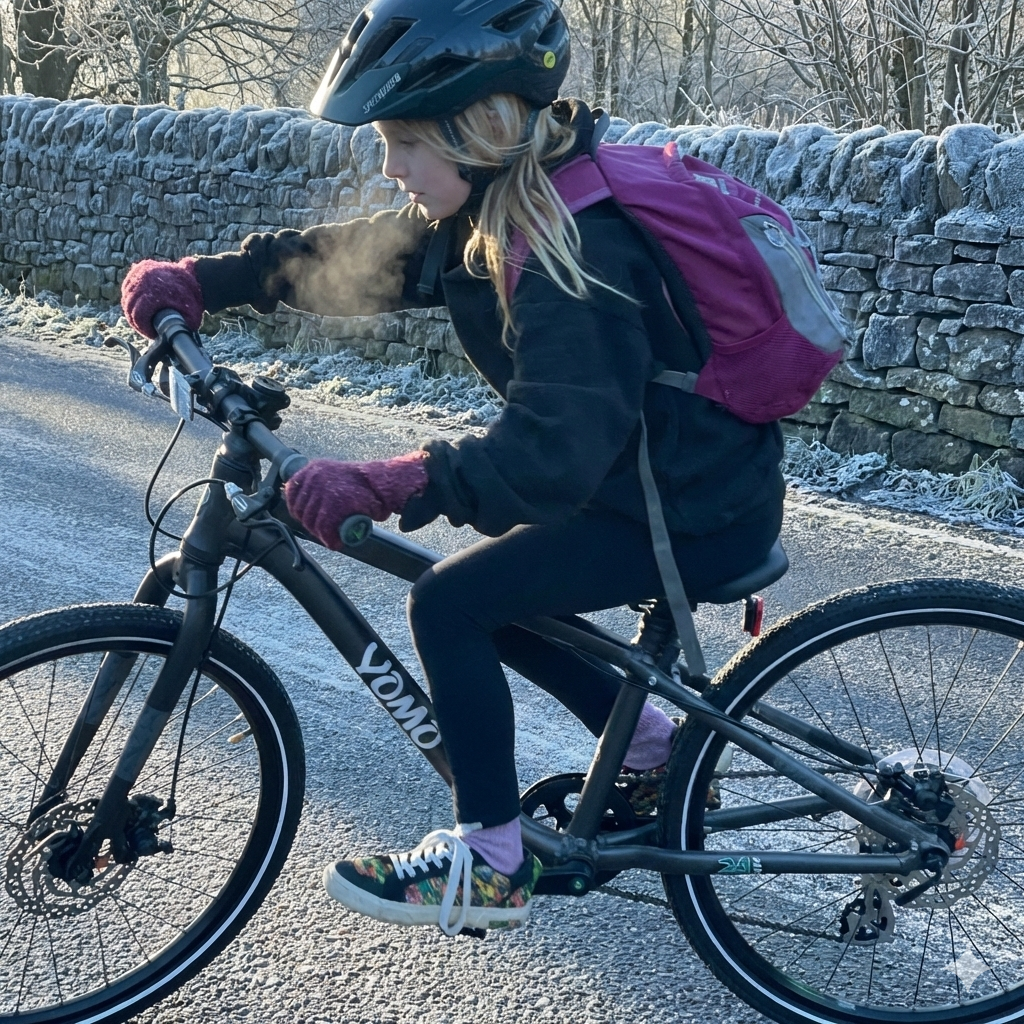
Cold mornings, darker evenings and wet roads can make cycling to school feel less appealing once winter arrives.
But winter doesn't automatically mean putting the bikes away. When the route, weather and child's ability are suitable, cycling can remain a practical part of the school routine throughout much of the colder season.
The key is preparation. Visibility, clothing, bike maintenance, route choice and road conditions matter more in winter, and there will be days when leaving the bike at home is the sensible decision.
Here's how to make winter school cycling more comfortable and manageable, plus the conditions that should make you reconsider the ride.
Why keep cycling to school during winter?
Children don't need perfect sunshine to enjoy riding a bike.
Continuing to cycle through suitable winter weather can help keep regular outdoor activity in the family routine and gives children more opportunities to practise everyday cycling skills.
It also reinforces the idea that a bicycle can be a practical way to travel rather than something reserved entirely for warm summer weekends.
If your family already cycles to school, continuing through the colder months can also avoid having to rebuild the habit every spring.
1. Winter cycling keeps everyday movement in the routine
Cold and wet weather often means families spend more time indoors.
A school journey provides a natural opportunity for children to keep moving without needing to organise another activity after school.
It doesn't need to be fast or strenuous. A steady ride that suits the child and the conditions is enough.
The objective should be arriving comfortably and safely, not turning the school journey into a training session.
2. Children learn to adapt their riding to different conditions
A dry summer path and a damp November road don't behave in exactly the same way.
With appropriate supervision, winter riding gives children opportunities to understand that conditions affect how they should ride.
They can learn to:
- slow down when surfaces are wet;
- allow more space for braking;
- avoid sudden steering movements;
- identify slippery leaves, drain covers and painted road markings;
- think about visibility before leaving home; and
- recognise when the conditions aren't suitable for cycling.
Those are useful cycling skills, but they should be introduced gradually. A school run isn't the place to deliberately expose a child to conditions beyond their ability.
3. Winter riding can build practical confidence
Confidence isn't about persuading a child to ride through difficult weather.
It comes from giving them manageable experiences where they learn that they can prepare appropriately, adjust their riding and make sensible decisions.
A child who learns to put on suitable clothing, check their lights and understand why they need to slow down on a damp surface is developing practical cycling awareness alongside their physical riding skills.
Just as importantly, they can learn that deciding not to ride because conditions are unsafe is good judgement, not failure.
4. Cycling can still be a practical school-run option
For families living within a suitable distance, cycling can avoid some of the queues and parking associated with busy school gates.
Whether it is genuinely faster depends on your route, local infrastructure and weather conditions.
In winter, always allow additional time. Wet roads, poor visibility and stronger winds may mean the journey should be slower than usual.
If you're rushing to arrive before the bell, you're more likely to encourage speeds or decisions that don't suit the conditions.
5. Year-round riding makes cycling feel normal
Children often learn routines from what families do repeatedly.
If bicycles disappear every time the temperature falls, cycling can easily become associated only with leisure and summer weather.
Continuing to ride on suitable winter days shows children that a bike can also be everyday transport.
That doesn't mean cycling every day regardless of conditions. The more useful habit is:
Check the weather. Check the bike. Check the route. Then decide whether riding makes sense today.
Winter visibility: make sure your child can be seen
Visibility deserves particular attention during the UK winter.
School journeys can take place in low light, rain, mist or darkness, and low winter sun can also make it difficult for road users to see clearly.
The Highway Code advises cyclists that light-coloured or fluorescent clothing can help visibility in daylight and poor light, while reflective clothing and accessories can improve visibility in darkness.
At night, bicycles must have a white front light and red rear light illuminated. The legally required reflectors must also be fitted.
For school journeys, check that:
- the front and rear lights work before leaving;
- lights aren't covered by bags or clothing;
- reflectors are clean;
- the child's clothing doesn't obscure the lights; and
- the rider is visible from more than one direction.
Even when lights aren't legally required because it is technically daylight, using them can be sensible in gloomy or reduced-visibility conditions.
What should children wear for winter cycling?
The goal is to keep your child warm and dry without restricting their movement or creating loose clothing that could interfere with the bicycle.
Layers usually give more flexibility than one extremely bulky garment.
Depending on the conditions, consider:
- a comfortable base layer;
- a jumper, fleece or other insulating layer;
- a suitable waterproof or wind-resistant outer layer;
- gloves that still allow the child to operate the brakes and gears comfortably;
- warm socks;
- clothing that doesn't hang near the chain or wheels; and
- bright or reflective elements when visibility is poor.
Check that gloves don't make the brake levers difficult to operate. Warm hands are important, but the child must still be able to control the bike correctly.
How should a child's helmet fit in winter?
A thick hat shouldn't be placed underneath a cycle helmet if it prevents the helmet fitting as designed.
The helmet needs to remain correctly positioned, level and securely fastened.
If your child needs additional warmth around their head or ears, use something compatible with the helmet manufacturer's guidance rather than compromising the helmet fit.
YOMO children's helmets are sized by head circumference rather than age. If you're unsure about fit, read our children's bike helmet sizing guide.
You can also view the YOMO Kids' Helmet range.
Wet roads need more braking distance
Rain changes how both the bicycle and road surface behave.
The Met Office's winter cycling guidance notes that grip can be significantly reduced on wet or icy roads and advises riders to allow greater stopping distances.
Teach children to:
- reduce their speed before corners;
- brake earlier than they would on a dry surface;
- apply the brakes smoothly rather than suddenly;
- avoid sharp direction changes; and
- look further ahead for potential hazards.
Leaves can become particularly slippery when wet, as can metal covers and painted markings.
Don't expect a child to handle a damp winter route at exactly the same speed they might use on a dry summer morning.
Ice changes the decision completely
Wet weather and icy weather shouldn't be treated as the same thing.
Ice can be extremely difficult to see and can cause a bicycle to lose grip suddenly.
The Met Office specifically advises cyclists that icy conditions are unpredictable and that there are situations where riding skill or equipment won't be enough to maintain control.
If the route is icy or conditions are uncertain, choosing another way to school can be the sensible option.
Be particularly cautious around:
- untreated cycle paths;
- shaded sections that receive little winter sun;
- bridges;
- standing water that may have frozen;
- road edges and gutters;
- metal covers; and
- areas where overnight temperatures have fallen below freezing.
Never assume a road or cycle route has been gritted simply because nearby roads have been treated.
What about snow?
Snow can obscure road markings and hide ice or other surface hazards underneath.
For a child's school journey, this generally isn't the time to treat the commute as an adventure challenge.
Check the conditions across the whole route, not just the pavement outside your house.
If snow, ice or poor visibility makes the route unpredictable, use an alternative form of transport and save cycling for another day.
Rain is different from dangerous weather
A normal wet morning doesn't necessarily mean cancelling a school ride.
With suitable clothing, good brakes and a safe route, many families can continue cycling in ordinary rain.
However, conditions such as flooding, severe winds, thick fog, ice or significant snow require a different judgement.
The Met Office recommends considering alternative transport during extreme conditions and checking local weather warnings before travelling.
Strong winds need particular care
Wind affects children differently from adults because smaller, lighter riders can be moved more noticeably by sudden gusts.
Crosswinds can be especially difficult on:
- exposed roads;
- bridges;
- open paths;
- gaps between buildings; and
- areas where a sheltered section suddenly becomes exposed.
If your child is struggling to maintain a predictable line because of the wind, continuing the ride isn't worthwhile simply for the sake of keeping the routine.
Check the forecast before leaving
Winter conditions can change quickly.
Make checking the forecast part of the school routine, particularly when overnight temperatures are close to freezing or warnings are in force.
Look beyond the temperature alone. Consider:
- ice;
- rain;
- snow;
- fog;
- wind strength;
- visibility; and
- any Met Office weather warnings.
There isn't one universal temperature below which children shouldn't cycle. Surface conditions, clothing, route exposure and the individual child matter more than a single number on the thermometer.
Keep the bike winter-ready
Winter conditions put additional demands on a bicycle.
Water, road dirt and grit can collect on the drivetrain and braking surfaces, so regular checks become particularly important.
The Highway Code advises cyclists to ensure that the bicycle is the correct size and that brakes, tyres, wheels, gears, chain, saddle, handlebars, lights and reflectors are in suitable condition.
For a school bike, regularly check:
Tyres
Look for damage or excessive wear and keep them inflated within the pressure range printed on the tyre.
Brakes
Check both brakes before leaving home. If braking feels noticeably different, don't send your child off and hope it improves during the journey.
Chain and gears
Keep the chain appropriately cleaned and lubricated and check that the gears operate correctly.
Lights and reflectors
Keep them clean and check batteries or charge levels regularly during the darker months.
Bolts and contact points
Check that the saddle and handlebars remain properly secured and correctly positioned.
Bike fit still matters in winter
Bulky clothing, darker conditions and slippery surfaces can make an oversized bicycle feel even less manageable.
A child should be able to reach the controls comfortably and handle the bike confidently at low speeds.
For YOMO bikes, choose size using inside leg first, then height and riding confidence.
If your child sits between two sizes, a learner or cautious rider will generally benefit from the more confidence-inspiring best fit now, rather than automatically choosing the larger bike for additional growing room.
Use the YOMO Perfect Size Finder to check the appropriate size.
Choose a winter-friendly route
The route you use in summer doesn't always have to be your winter route.
Where practical, consider:
- well-lit routes;
- segregated cycleways;
- quieter streets;
- lower-speed roads;
- routes that are more likely to be treated during icy weather; and
- avoiding exposed sections during strong winds.
The Met Office also points out that traffic-free routes can sometimes be poorly lit or untreated in winter, so don't assume they are automatically the best option in every condition.
Give the journey more time
A winter school run should often be slower than the same journey in summer.
Leave a little earlier so your child doesn't feel pressure to rush.
That gives them time to:
- brake earlier;
- slow down at corners;
- walk a difficult section if necessary;
- deal with wet surfaces calmly; and
- arrive without turning the journey into a race against the school bell.
When should you skip cycling to school?
There is no prize for riding every day.
Consider another form of transport when:
- there is ice on the route;
- snow makes the surface unpredictable;
- there is flooding or significant standing water;
- visibility is severely reduced;
- strong winds make it difficult for your child to control the bike;
- a weather warning makes the journey inappropriate;
- the bike isn't mechanically ready; or
- your child doesn't have the ability or confidence for the conditions.
Being a year-round cyclist includes knowing when not to cycle.
Winter cycling to school checklist
Before leaving, ask:
- Have I checked today's weather and warnings?
- Is there any risk of ice on the route?
- Are the front and rear lights working?
- Is my child visible in today's conditions?
- Can they operate the brakes comfortably while wearing gloves?
- Are the tyres and brakes in good condition?
- Does the helmet still fit correctly with their winter clothing?
- Is the planned route suitable today?
- Have we allowed enough time to ride more slowly?
If one of those answers causes concern, address it before setting off.
Frequently asked questions about winter school cycling
Is it safe for children to cycle to school in winter?
It can be appropriate when the child has suitable cycling skills, the bike is correctly maintained, visibility is good enough and the route and weather conditions are suitable. Winter introduces additional hazards, so the decision should be made day by day rather than assuming every journey is safe.
What temperature is too cold for a child to cycle?
There isn't a single universal temperature cut-off. Appropriate clothing, wind, precipitation and surface conditions all matter. Ice is usually a much more important warning sign than temperature alone.
Do children need bike lights during winter mornings?
If they are riding at night, the law requires an illuminated white front light and red rear light, along with the required reflectors. Lights can also be useful during gloomy daylight or reduced visibility.
Should children cycle when the road is icy?
For a routine school journey, avoiding icy conditions is generally the sensible approach. Ice can cause sudden loss of grip and may be difficult to see.
Can children cycle to school in rain?
Ordinary rain doesn't necessarily prevent cycling, provided the route remains safe, the bike is in good working order and the child has suitable clothing and skills. Ride more slowly, allow extra braking distance and reassess the journey if rain becomes severe or flooding develops.
What gloves are best for children cycling in winter?
Choose gloves that keep their hands comfortable while still allowing them to grip the handlebars and operate the brake levers and gears properly. Avoid gloves so bulky that they interfere with the controls.
Should my child wear a woolly hat under their helmet?
Don't add thick clothing underneath a helmet if it changes how the helmet fits or sits on the head. Follow the helmet manufacturer's fitting guidance and use compatible thin headwear where appropriate.
Winter doesn't have to end the school cycling routine
Winter cycling isn't about proving that children can ride through every condition.
It's about recognising that plenty of colder days are perfectly usable for everyday cycling when families prepare properly.
Keep the bike maintained, make the rider visible, choose suitable clothing, adjust the route and speed to the conditions and be willing to choose another way to school when the weather isn't appropriate.
That gives children a much more useful lesson than simply riding regardless: confident cyclists adapt to the conditions and make sensible decisions.
For more general school-run advice, read 5 Reasons to Cycle to School and How to Do It Safely.
If your child needs a new bike for regular school journeys, use the YOMO Perfect Size Finder or explore the YOMO children's bike range.


