
Moving from a balance bike to a first pedal bike is one of the biggest milestones in a young child's cycling journey.
And if that milestone happens to arrive around Christmas, a new pedal bike can make a memorable gift.
But readiness matters more than the date on the calendar.
A child doesn't need to move to pedals simply because they've reached a particular age. The best time is when they have developed enough balance and control, show an interest in pedalling and, importantly, fit the next bike properly.
Here's how to tell whether your child is ready to move from a balance bike to their first pedal bike, and how to choose the right size for Christmas morning.
When is a child ready to move from a balance bike to pedals?
There's no fixed age when every child should make the transition.
Instead, look at what your child can already do on their balance bike.
Useful signs include:
- they can glide with both feet off the ground for several seconds;
- they steer confidently rather than constantly correcting themselves;
- they can slow down and stop under control;
- they can look ahead while riding;
- they are comfortable starting independently; and
- they are showing interest in pedal bikes.
A child doesn't need to have perfected every cycling skill before trying pedals, but good balance makes the transition much easier because they are learning one major new movement — pedalling — rather than balance and pedalling simultaneously.
Balance matters more than age
One child may be ready for pedals at three. Another may be happier on a balance bike for longer.
Both can be completely appropriate.
Age should therefore be treated as a rough guide rather than a deadline.
The more useful questions are:
- Can they balance?
- Can they steer?
- Can they stop?
- Do they want to try pedals?
- Do they physically fit an appropriate pedal bike?
If the answer to several of those questions is no, there's no advantage in rushing the transition simply because Christmas is approaching.
Why balance bikes can make the move to pedals easier
A balance bike separates two major cycling skills.
Children first learn:
- balance;
- steering;
- speed control; and
- confidence with two wheels.
Pedalling can then be introduced once those fundamentals feel familiar.
That is why many children who have become confident balance-bike riders can progress to a pedal bike without needing stabilisers.
If you're still deciding between learning methods, read our guide to balance bikes versus stabilisers.
Don't make Christmas the deadline
A new bike can be an exciting Christmas present, but avoid turning Christmas morning into a test.
If your child hasn't ridden a pedal bike before, they don't need to unwrap it and immediately ride away perfectly.
Let them:
- look at the bike;
- sit on it;
- understand the brakes;
- walk or scoot it around if they want;
- practise somewhere quiet; and
- progress at their own pace.
The gift should create an opportunity to learn, not an expectation that they must master pedalling on Christmas Day.
The first thing to check: does the pedal bike actually fit?
A child can have excellent balance skills and still struggle if the new bicycle is too large.
For a first pedal bike, reassuring access to the ground, comfortable reach to the handlebars and easy access to the brake levers can all make the new experience feel more manageable.
Don't choose the size primarily from age or because you want the bicycle to last longer.
For YOMO bikes, inside leg should lead the sizing decision, supported by height and riding confidence.
Use the YOMO Perfect Size Finder before ordering.
Why the YOMO 14 is designed for the balance-bike transition
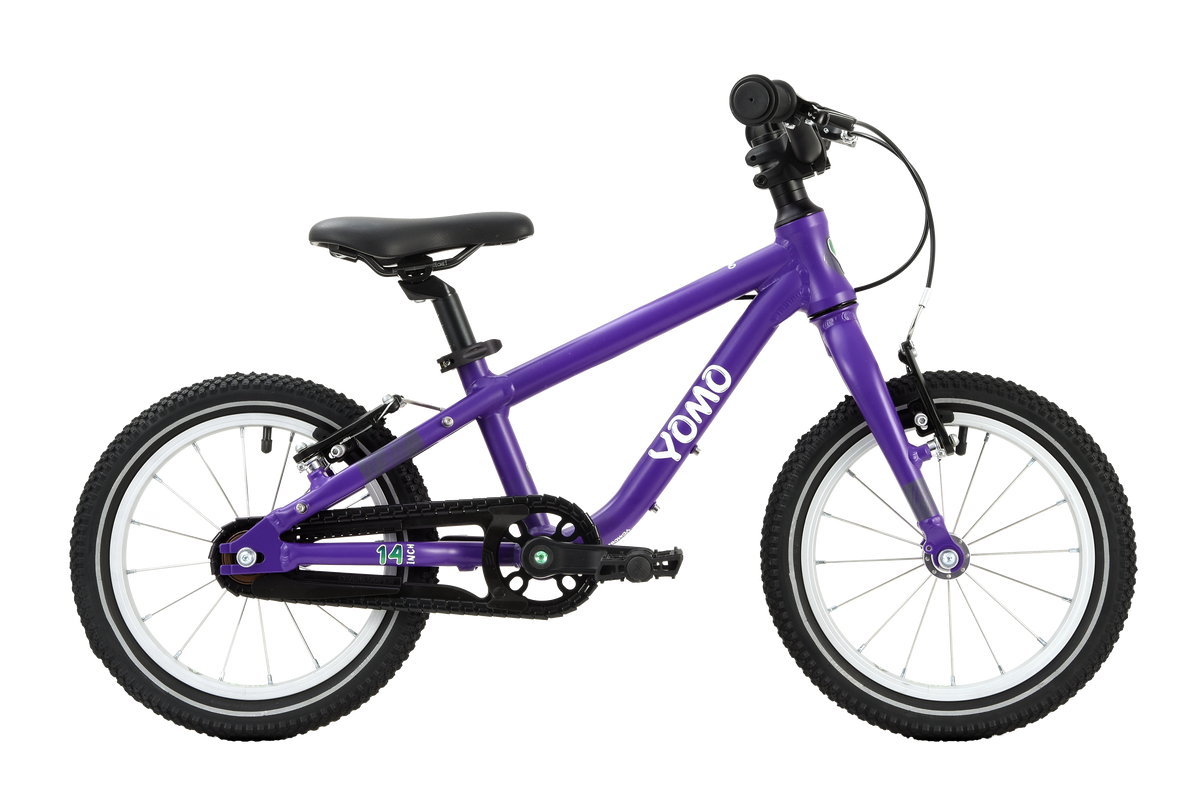
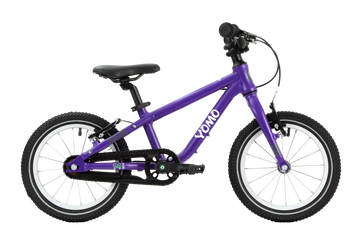
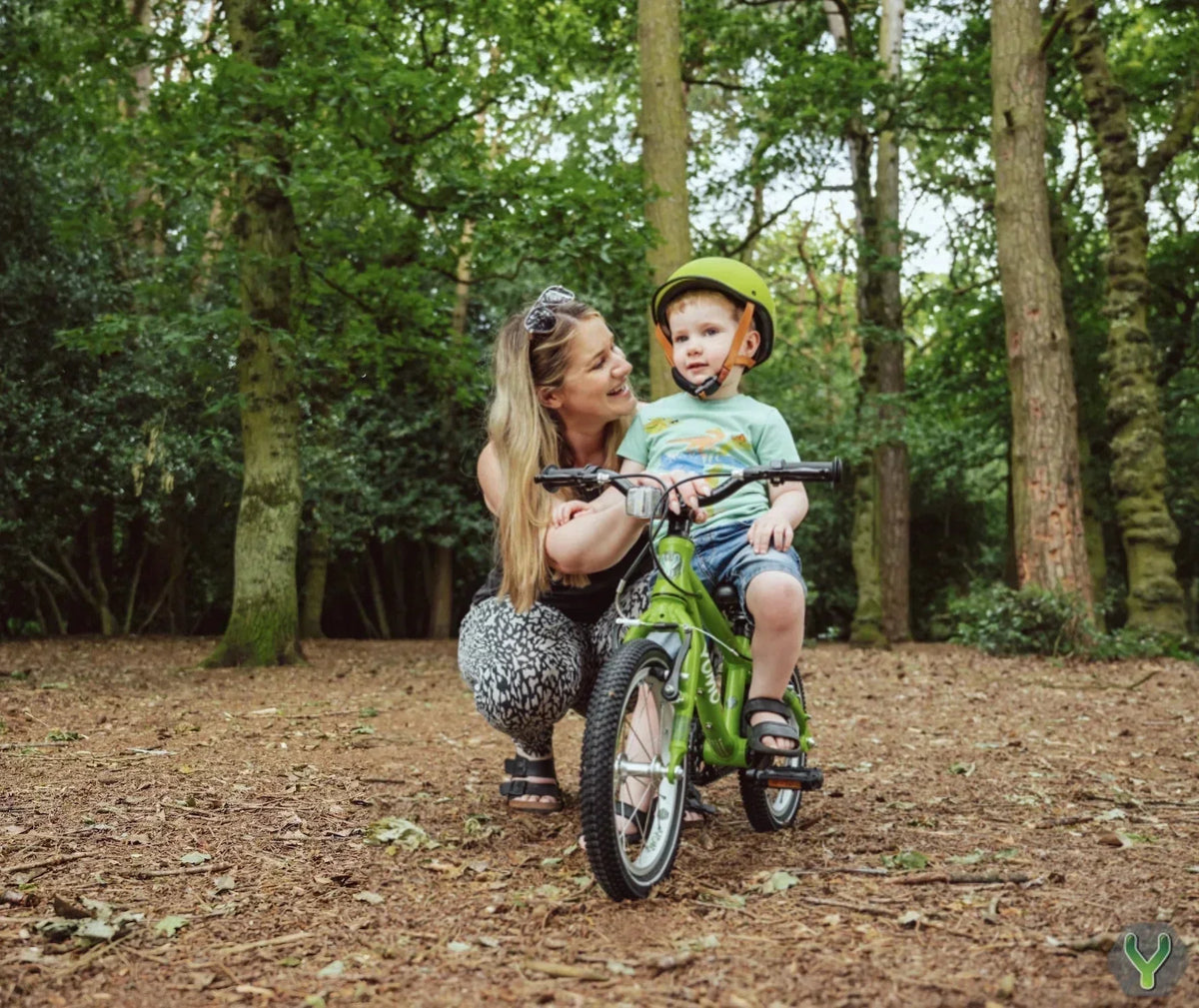
The YOMO 14 is YOMO's smallest current pedal bike and is specifically designed as the transition size after a balance bike.
Current fit guidance is:
- Approximate age: 3–5 years
- Inside leg: 41–53 cm
- Rider height: 95–115 cm
- Bike weight: 5.5 kg
- Drivetrain: single speed
- Setup: approximately 99% assembled
A confident rider may fit from approximately 40.5 cm inside leg, while a beginner or more cautious rider will generally need nearer 45 cm.
That difference matters for a first pedal bike.
A cautious learner often benefits from easier access to the ground, while a child who is already highly confident balancing and stopping may manage the lower end of the range appropriately.

Why bike weight matters for a first pedal bike
Young children are small relative to the bicycles they're learning to control, so unnecessary bike weight can make simple tasks more difficult.
A lighter first pedal bike can be easier for a child to:
- push away from a standing start;
- steer at lower speeds;
- manoeuvre;
- pick up after putting it down;
- ride uphill; and
- control when stopping.
At approximately 5.5 kg, the YOMO 14 is designed to keep the bike manageable while a young rider concentrates on developing their new pedalling skills.
Keep the first pedal bike simple
Young riders already have plenty to think about when pedals are introduced.
They are coordinating:
- balance;
- steering;
- pedalling;
- braking; and
- looking where they want to go.
The YOMO 14 therefore uses a single-speed drivetrain.
There are no gears for the child to manage while they're learning the basic skills of riding independently.
Gears are introduced later in the YOMO range when riders are ready for longer journeys and hills.
Should you use stabilisers on the first pedal bike?
A child who can already balance confidently may not need stabilisers.
Stabilisers change the way a bicycle balances, so a confident balance-bike rider may find it more natural to move directly onto two wheels.
That doesn't mean every child needs to ride away immediately.
You can still make the transition gradual by choosing a flat, traffic-free space and allowing plenty of time to practise starts, pedalling and controlled stopping.
Our guide to learning to ride without stabilisers explains the process step by step.
How to introduce the pedals
If your child is already comfortable balancing, concentrate on one new skill at a time.
Start somewhere easy
Choose a flat, smooth, traffic-free area with plenty of space.
Show them the pedals
Let the child understand where their feet need to go before trying to move.
Practise the starting position
Many beginners find it easier when one pedal starts slightly forward and raised, allowing them to push down firmly to begin moving.
Look ahead
Encourage the child to look where they want to go rather than down at their feet.
Keep stopping practice simple
Make sure they understand how the brakes work and practise gentle controlled stops before trying to ride further.
What if they struggle on the first attempt?
That's normal.
Being confident on a balance bike doesn't guarantee that pedalling will make sense immediately.
Some children understand the circular pedalling movement straight away. Others need several sessions.
If frustration starts building:
- finish the session;
- return to something they already enjoy;
- try again another day; and
- avoid comparing them with siblings or other children.
The aim is to create a positive relationship with cycling, not achieve a particular result by a particular date.
How to make a Christmas bike reveal special
If the new pedal bike is a Christmas surprise, a little preparation makes the morning easier.
Check the size before ordering
Measure your child's inside leg discreetly before Christmas rather than guessing from their age.
Assemble the bike beforehand
The YOMO 14 arrives approximately 99% assembled, but the final setup and safety checks still need to be completed before riding.
Do this before Christmas morning so the child isn't waiting while the adults find tools and read instructions.
Set the approximate saddle height
You can prepare the bike in advance and then make the final rider-specific adjustment once your child is present.
Add a bow rather than wrapping the entire bike
A large ribbon or bow keeps the reveal simple and avoids having to cover the assembled bicycle in wrapping paper.
Don't promise the first ride
Weather, daylight and the child's mood may mean Christmas Day isn't the right moment for learning.
A Boxing Day park ride or another quiet day during the holidays can work just as well.
Remember the helmet
A new bicycle is also a good opportunity to recheck helmet fit.
Children's helmets should be selected by head circumference rather than age.
Under YOMO's current direct website offer, an eligible YOMO helmet can be included free with a qualifying YOMO bike purchase when the helmet is selected and added alongside the bike. The offer is subject to availability and should not be assumed to apply automatically to dealer purchases.
View YOMO Kids' Helmets and sizing.
What happens to the balance bike afterwards?
If the balance bike still fits another child in the family, passing it down can give it another useful chapter.
Eligible YOMO bikes may also qualify for YOMO BikeTrade.
The current BikeTrade programme offers up to 50% credit, subject to inspection, based on the original bike price excluding VAT, delivery and accessories.
Eligibility depends on factors including the model, purchase date, condition and completeness, and final credit is confirmed after physical inspection.
The current programme is designed for eligible YOMO bikes traded within 24 months of the original purchase date.

Frequently asked questions about moving from a balance bike to pedals
What age should a child move from a balance bike to a pedal bike?
There isn't a fixed age. Look at balance, steering, stopping ability, interest in pedals and whether the child physically fits an appropriate pedal bike. Age should only be used as a rough guide.
Can a three-year-old ride a pedal bike?
Some three-year-olds can, provided their measurements, coordination and confidence are appropriate. The YOMO 14 is designed for approximately ages 3–5, but inside leg and current riding ability matter more than age alone.
Does a child need stabilisers after using a balance bike?
Not necessarily. A child who has already learned to balance confidently may be able to progress directly to a pedal bike without stabilisers. Give them time to learn the additional skill of pedalling.
What size first pedal bike should I buy?
Choose from the child's actual measurements rather than simply selecting a 14-inch bike because it is commonly described as a first pedal size.
For the YOMO 14, the published inside-leg range is approximately 41–53 cm, with different minimum recommendations depending on confidence.
What if my child fits both a 14-inch and 16-inch bike?
Don't automatically choose the larger bike because it will theoretically last longer.
Consider the best fit now versus the option with more room to grow. A cautious beginner may benefit from the smaller bike, while a confident rider whose measurements comfortably meet the next size may be ready to move up.
Use the Perfect Size Finder to compare the two.
How long does it take to learn to pedal after a balance bike?
There isn't a reliable universal timeframe. Some children understand pedalling quickly, while others need several short sessions. Let the child progress without turning the transition into a deadline.
A Christmas upgrade should still be the right upgrade
Moving from a balance bike to a pedal bike is an exciting milestone, and Christmas can be a wonderful moment to mark it.
But the best present isn't simply the biggest bike that will fit under the tree.
It's the bike your child can comfortably control now.
Check their measurements, consider their confidence and make sure they're genuinely ready for the next step.
When balance, fit and interest all come together, pedals can open a completely new chapter of family cycling.
Check your child's size with the YOMO Perfect Size Finder or explore the YOMO 14 first pedal bike.